Categories
Computers and Internet SQL Server

Installing Balanced Data Distributor on SQL Server 2008 R2 SP1

Edit: This post refers to an older version of the BDD installer. As per JasonH’s comment below, Microsoft has released a new installation package which should hopefully fix the installation bug. It can be found here: http://www.microsoft.com/en-us/download/details.aspx?id=4123

Original post:

Microsoft’s Balanced Data Distributor does not install on top of SQL Server 2008 R2 SP1. It installs fine without SP1 but otherwise comes up with the error:

“The installation is not successful. Check the following prerequisites: 1. Either Integration Services or BIDS has to be installed. 2. The version of these components has to be either SQL Server 2008 SP2 (or future SPs) or SQL Server 2008 R2 (or future SPs)”

In my case all the pre-requisites were met. As per this thread I examined the registry keys it was checking for the version numbers using Process Monitor. I then modified the keys to pretend I was running SQL Server 2008 R2 RTM, ran the BDD installer again (successfully) and modified the keys back to their original values.

Warning: This is not best practice advice! If you do the same as I did and your production system is rendered unusable, this will be entirely your fault. I did this on a throwaway development environment to save time uninstalling SP1 and reinstalling it.

The keys I altered were all in the following path:

  • HKLM\SOFTWARE\Microsoft\Microsoft SQL Server\100\

The specific keys and the values I set them to were:

  • DTS\Setup\SP = 0
  • DTS\Setup\Version = 10.50.1600.1
  • BIDS\Setup\SP = 0
  • BIDS\Setup\Version = 10.50.1600.1

When setting up a production system, please ensure you apply the BDD installation before SP1. Don’t use this technique, which will probably render your environment unsupportable!
Categories
Computers and Internet

Deploying ASP.NET MVC 3 Razor – Missing System.Web.Helpers (and others)

Last week I was racing against time to complete a QA deployment of an ASP.NET MVC 3 application that uses the Razor view engine.

The deployment was to a clean Windows Server 2008 R2 box. I had already completed the following steps:

  • Used the Web Platform Installer to install “IIS 7 Recommended Configuration”.
  • Altered my TFS 2010 Build Definition and used the WebDeploy tool to create a deployment package and install it on the server.
  • Changed the “copy local” flag to true on the System.Web.Mvc assembly reference in my web project (as suggested in several pre-Razor articles about BIN deployment of ASP.NET MVC sites)
  • Ensured I was using a .NET 4 application pool.

Once all this was done and I browsed to the home page of the application, I started to get a series of errors about missing DLLs, starting with System.Web.Helpers. Additional missing assemblies included:

  • Microsoft.Web.Infrastructure
  • System.Web.Razor
  • System.Web.WebPages.Administration
  • System.Web.WebPages.Deployment
  • System.Web.WebPages.Razor

The solution compiled fine and ran okay on all the development machines. It turned out that these DLLs are needed for Razor based web pages and are a requirement over and above the standard ASP.NET MVC references.

My initial solution was to locate these assemblies and add references to them from the project with “copy local” as “true”. The assemblies are in the following folder on development machines:

C:\Program Files (x86)\Microsoft ASP.NET\ASP.NET Web Pages\v1.0\Assemblies

However, it was, as I say, a series of errors as there were plenty of DLLs that needed to be added. On further searching it turned out that there is support in Visual Studio 2010 SP1 for including all of these dependent assemblies in the deployment without the need to add references to them.

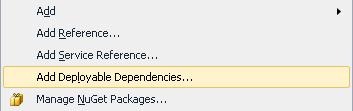
AddDeployableDependenciesSimply right click on the web project in solution explorer and select “Add Deployable Dependencies” then select “ASP.NET Web Pages with Razor Syntax”. This adds the files to a “_bin_deployableAssemblies” folder in the web project. The contents of this folder are added to the web deployment package. Note that you can also check “ASP.NET MVC” so that you don’t have to remember to set “copy local” to “true” for the System.Web.Mvc assembly.

NOTE: You may have to remove the WebMatrix DLLs, added by this step, from the _bin_deployableAssemblies folder as they have the detrimental effect of redirecting the user to “Account/Logon” on every page request in some instances, regardless of the settings in your own web.config file. See this StackOverflow answer and this Microsoft Connect issue for more information.

The “Add Deployable Dependencies” is covered in more detail by Phil Haack in this blog post:

http://haacked.com/archive/2011/05/25/bin-deploying-asp-net-mvc-3.aspx

As many of the comments at the end of his blog point out, this does come across as a hack. One alternative would be to have some kind standalone installer for ASP.NET MVC 3 with Razor and to run this on the target server. Another alternative would be to add another option in the Web Platform Installer. Either of these would have worked great in my situation, but not when trying to deploy in a more locked down environment.

Categories
Uncategorized

Syncing Visual Studio Database Project With Entity Framework

Or: Quirks of Using Entity Designer Database Generation Power Pack

If you’re searching for a way to synchronise a “Visual Studio Database Project” (also known as “SQL Server Database Project” or “TSData Project”) with an Entity Framework model, you’ve probably already encountered the “Entity Designer Database Generation Power Pack”.

With model first development, the most basic use case is to synchronise the database project with the model. If you are trying to achieve this, you need to be aware of conventions that have been baked into the tool:

  1. Your “.edmx” file must have the same name as the “.dbproj” (i.e. database project name).
    • It is just the file name of the model that is important.
    • Neither the “Namespace” or “Entity Container Name” properties of the model need to match the file name. In fact, you will not be able to use names containing full-stops/periods (“.”) in these properties, but you may well require that for the file name if you’ve named your database project in this fashion.
    • It is just the file name of the database project that is important too. The name of the
  2. Your database project must lie in the root of the solution structure. i.e. do not put your database project in a solution folder.

Footnote

There won’t be any more development of the “Entity Designer Database Generation Power Pack”, as the functionality is being provided as part of the “SQL Server Developer Tools”, code named Juneau. This would be the better toolset to use to satisfy this use case.

Categories
Environment

New UK Electricity Pylons?

This video on new pylon designs misses the option of putting the cables underground (or underwater) instead. This would have a higher up front cost but lead to much better looking countryside and probably lower total cost of ownership.

The lower total cost of ownership was the argument Dr Liam Fox (Defence Secretary) used in his recent objection to a scheme to place new pylons in his Somerset constituency.

If we do have to endure yet more pylons, I’d vote for the sail design, “Plexus”, by Amanda Levete Architects & Arup, shown in the attached photo.

plexus-pylo_660[1]

Categories
Computers and Internet

A SPDY end to web site content sharding?

With the advent of Google’s SPDY improvements to the HTTP protocol, could we see an end in sight to the practice of sharding content on web sites?

In the news today (from The Register) Google report a 15% increase in speed when using SPDY to communicate to their web services from Chrome browsers. The SPDY technology seems to establish a single TCP session in which multiple HTTP like requests are managed in an efficient manner. It means, for instance, that multiple requests can be processed concurrently rather than the two (or six in recent browsers) per domain limit.

The practice of content sharding is used, in part, to achieve a similar effect. It allows browsers to believe they’re downloading from different servers and so they can initiate more concurrent connections. Another benefit is in reducing the payload of cookies by using domains the cookies haven’t been set for.

SPDY should take care of all of this for us. And, in fact, using separate domains to serve images, CSS and Javascript will perform worse with SPDY as there will be multiple TCP sessions established. So, assuming this technology becomes more widely available on the server side, we should probably start selectively sharding content on the basis of the capabilities of the user agent.

Technorati Tags: ,,,
Categories
Computers and Internet

EU Cookies Directive & eCommerce Analytics

Article 66 of this set of directives, http://eur-lex.europa.eu/LexUriServ/LexUriServ.do?uri=OJ:L:2009:337:0011:0036:En:PDF, from the Official Journal of the European Union states that:

“Third parties may wish to store information on the equipment  of a user, or gain  access to information  already stored, for a number of purposes, ranging  from the legitimate  (such as certain  types of cookies)  to those involving unwarranted intrusion into the private sphere (such as spy­ware or viruses). It is therefore of paramount importance that users be provided with clear and comprehensive information when engaging in any activity which could result in such storage or gaining of access. The methods of providing information and offering the right to refuse should be as user-friendly as possible. Exceptions to the obligation to provide information and offer the right to refuse should be limited to those situations where the technical storage or access is strictly necessary for the legitimate purpose of enabling the use of a specific service explicitly requested by the subscriber or user. Where it is technically possible and effective, in accordance with the relevant provisions of Directive 95/46/EC, the user’s consent to processing may be expressed by using the appropriate settings of a browser or other application. The enforcement of these requirements should be made more effective by way of enhanced powers granted to the relevant national authorities.”

It’s not clear to me what “third parties” constitutes, but I assume it does not include the owner of the website the user is visiting. So Google Analytics / Ominiture Site Catalyst would count as a third party.

It’s possible you could interpret the use of an eCommerce site as a user explicitly requesting the service of browsing products for the purpose of purchasing. If you could, then the storage of analytics tags could be interpreted as being necessary to provide an effective browse and purchase experience through process of analysis and improvement. Then it might pass as being the “legitimate purpose of enabling the use of a specific service explicitly requested by the subscriber or user”. It does feel rather tenuous though.

This is all personal opinion and is not legal advice. Please seek somewhere else to pin the blame if you get taken to court for not asking your customers for permission to store cookies!

Categories
Uncategorized

Internet Explorer 6 – Dying Days?

IE 6 was once the most popular browser on the market. This despite its lack of adherence to standards and its poor rendering performance. These days it’s on the way out, and no-one in IT is mourning it. The graph here shows the trend of IE 6’s market share over the last year and a half (source: http://www.w3counter.com/globalstats.php).

The story’s not that simple though. Corporations still persist in forcing their employees to use the browser, doubling its share during working hours, and Microsoft have still committed to supporting it for some years yet. Problems with an attack on Google via IE6 security flaws in December 2009 don’t seem to have galvanised companies into ditching it, but maybe Google’s subsequent withdrawal of support for IE 6 in GMail and other Google Apps “later in 2010” will accelerate this.

Categories
Uncategorized

ASP.NET HTTP 400 Bad Request Exception

Someone on my project pointed me at this useful article from Alois Kraus about the 400 “Bad Request” exception coming from ASP.NET. In particular, it cleared up the way that length checking is performed on a URL in an incoming request.

On my project we are relying on a key from FAST ImPulse, a search engine for eCommerce apps. This key is included in a URL. In certain deep search scenarios, e.g. lots of filtering on facets of a product, this key can become very long. This has been resulting in the “Bad Request” messages. It turns out that there is a difference between including this key in the path of the URL and as a query string parameter. For example:

http://www.example.com/{key}/results.aspx

http://www.example.com/results.aspx?key={key}

If {key} is close to 260 characters, the first URL will be rejected by ASP.NET whereas the second will be accepted. ASP.NET only allows the path part of the URL to reach 260 characters. As the article mentions, ASP.NET 4 allows this limit to be changed.

Categories
Uncategorized

Setting up a keyboard shortcut for View History in Visual Studio using TFS

Note – this post refers to and is tested with Visual Studio Team System 2008.

If you’re using Visual Studio and Team Foundation Server, you’ll probably be viewing the history of files in your solution fairly regularly. Unfortunately there’s no keyboard shortcut set up for that. If you wish to set one up, here’s what to do:

  1. Go to the “Tools” menu and select “Options” and then “Keyboard”
  2. In "Show commands containing:” type “TfsHistory” and select “File.TfsHistory” in the list.
  3. In “Press shortcut keys”, put in your desired shortcut. Take a note of anything appearing in “Shortcut currently used by” to ensure you don’t overwrite anything.
  4. Click “Assign”

In the screenshot below, I’m setting up “Ctrl+Shift+Alt+V” followed by “H” to be the short cut. Once I click “Assign”, I’m done.

Categories
Environment

Love Clean Streets – The Result

I posted recently about http://www.lovecleanstreets.org/ and the mobile phone app of the same name. I wasn’t sure that Merton Council were going to act on anything I’d reported, but I’m happy to say that they’ve sorted out all the graffiti that was on public property already. So, a genuinely useful service.

I do wonder if graffiti taggers will start using it to figure out where the freshly painted surfaces are for them to be the first to tag up again!

del.icio.us Tags: